
Sex Offender Checks in Brevard County
The Florida Sexual Offender and Predator Registry is the first official channel for a Brevard County sex offender search. FDLE lets the public search statewide registration data by a person's name or by place. Selecting Brevard in the county field narrows a location search without forcing a name. A neighborhood search is better when the question concerns a home, school route, park, or other address. The registry also offers alerts tied to a place radius or to a specific registrant.
Start with enough detail to reduce false matches, then confirm the profile rather than relying on the results list. Partial names can help with spelling variants. Blank-name location searches can return people registered in the chosen area. Compare aliases, physical description, photograph date, designation, current status, address dates, and conviction jurisdiction. FDLE states that agencies and registrants contribute the data and that FDLE does not independently confirm every submission, so a profile should be read as current public registration information rather than a guarantee about every fact.
No separate Brevard County portal replaces the FDLE search. Local agencies perform registration and compliance work, but the state registry is the public search layer documented for the county. If a search concerns a current address, preserve the profile date and check again before acting on it. Registration data changes as people report moves, enter or leave custody, update vehicles, or receive a new status. A single undated screenshot loses that context.
Brevard Registry Search Options
Florida provides two useful paths from the registry home screen. The person search works best when a name or alias is known. The neighborhood search begins with an address, city, ZIP code, and radius. County filtering is useful for a broader Brevard County registry review, but county lines do not define every daily route. Someone near the county boundary may appear more clearly through a radius search.
The official registry landing screen is shown in the image below. Its separate person and neighborhood paths make the choice of search method clear before any personal data is entered.
A name search and a neighborhood search answer different questions. Names help confirm a known person. Place tools show reported registrations around a location, even when the reader does not know who may appear. Neither proves that every person on the map is present at that moment. The radius is a search boundary, not a safety boundary, and markers should be opened individually to read their underlying dates and classifications.
View the FDLE registry home and search choices.
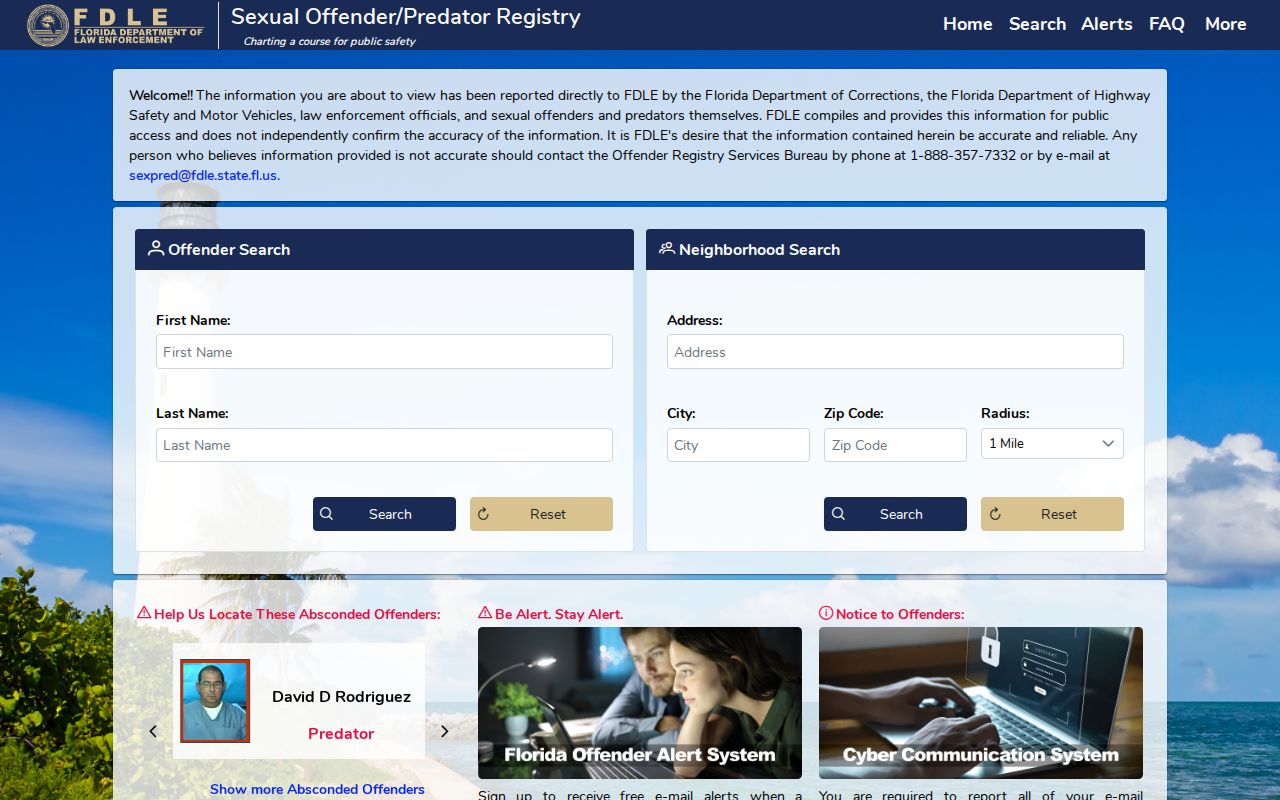
For Brevard County awareness, choose the path that matches the question and save the profile date when documenting a result.
How to Search the Florida Registry
The FDLE Offender Registry Services Bureau runs the advanced search. The form supports partial names and geographic fields, statutory offender categories, status choices, and options to include aliases or thumbnail images. At least one name or location field must be supplied. Search terms should be broad enough to find spelling variants but specific enough to keep the result set useful.
- Open the FDLE advanced registry search and review its public-use notice.
- Enter a partial or full name, or choose Brevard County with a city or ZIP code.
- Refine by offender type or status only when that distinction matters.
- Open the full profile and compare photo date, aliases, addresses, status, and offense details.
| Field Label | Type | Required | Notes |
|---|---|---|---|
| First and last name | Text | No | Partial names are supported. |
| City or ZIP | Text | No | Either may anchor a location search. |
| County | Dropdown | No | Select Brevard for county results. |
| Offender type and status | Dropdown and multi-select | No | Includes statutory categories and custody or release statuses. |
| Neighborhood address and radius | Location fields | No | Finds registrations near a chosen point. |
The advanced interface shows how Florida separates identity fields from place and status filters. Open the official advanced registry search.
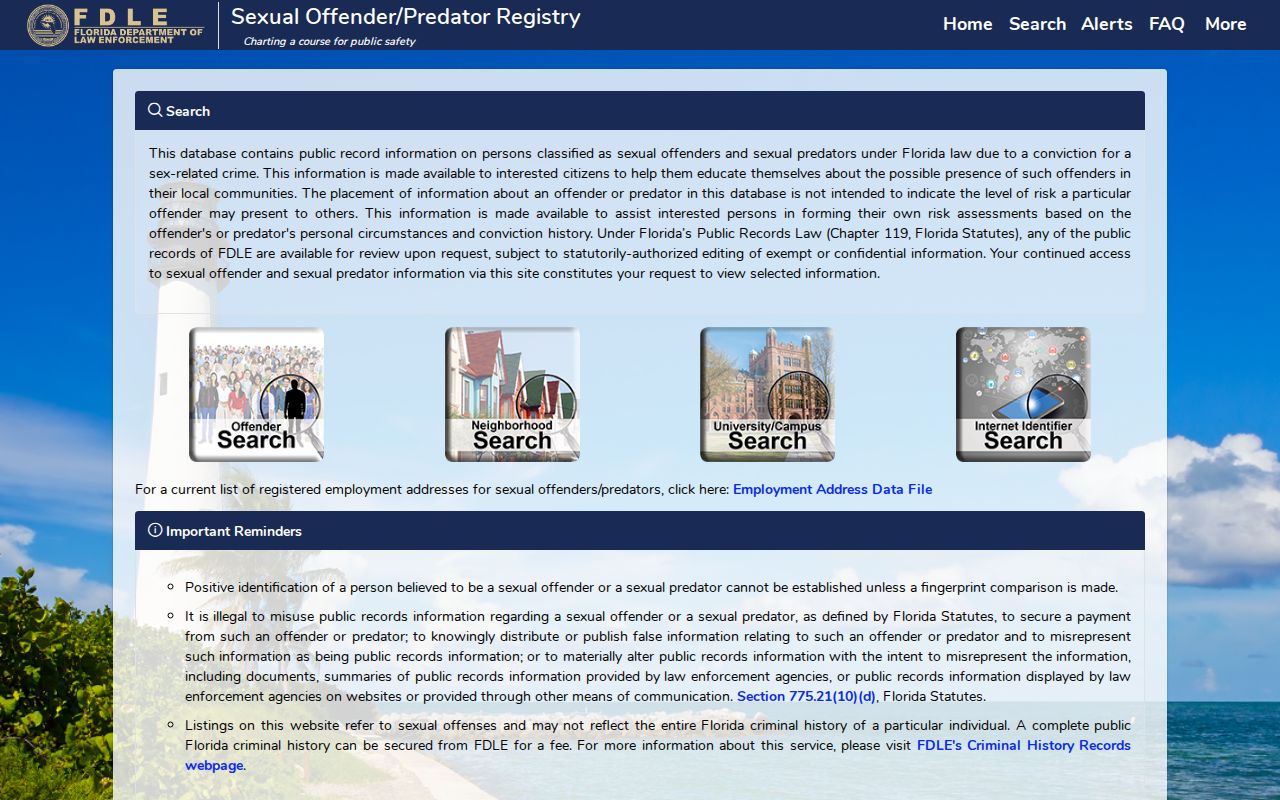
These controls allow a Brevard County search without assuming that a person has only one spelling, address, or status.
Result handling also matters. FDLE allows selected profiles to be printed, but a printout reflects the registry at the time it was made. For a common name, compare middle names and aliases before comparing photographs. Then check the permanent, temporary, or transient address type and the last reported date. If those details do not align, return to the results and examine other possible matches instead of forcing an identity match.
Brevard Searches Across State Lines
A Florida-only result does not answer a cross-state question. The U.S. Department of Justice's Dru Sjodin National Sex Offender Public Website searches participating jurisdictions through one national layer. It is useful when a person recently moved, an address sits near a state line during travel, or the known conviction jurisdiction was outside Florida. Return to FDLE for the full Florida profile because the state system supplies Florida-specific status, address, vehicle, registration, and flyer details.
The national portal's search screen illustrates its broader geographic role.
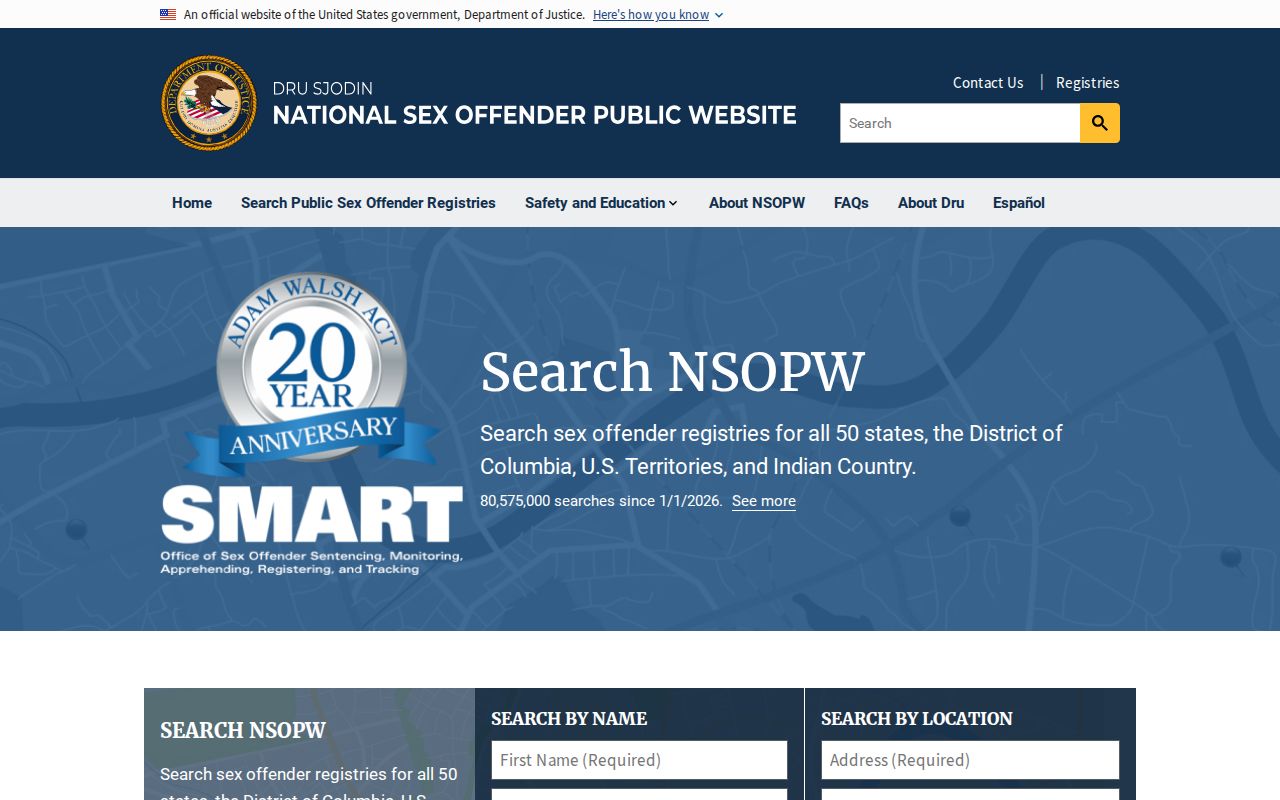
Use NSOPW as a second layer, not as a replacement for the detailed Brevard County and Florida registry record.
Jurisdictions contribute different public fields to the national system. A sparse national card does not mean that the home jurisdiction lacks more detail. Follow the record back to that jurisdiction's official registry. When Florida is the registering state, FDLE supplies the controlling public profile. When another state maintains the registration, use its official page for current reporting terms, address types, and correction instructions.
Inside a Brevard Registry Profile
A Brevard County registry profile joins identification, registration, address, vehicle, supervision, and qualifying-offense fields. It is not a full rap sheet. The listed offense supports the registration duty, while unrelated arrests or case documents belong in other official systems. Dates matter. A recent address report paired with an older photograph requires more care than a quick visual match.
| Name & Aliases | Primary name and reported alternate names used to confirm identity. |
|---|---|
| Photo & Physical Description | Photograph and date, demographics, scars, marks, and tattoos. |
| Registered Addresses | Permanent, temporary, or transient addresses with reported dates. |
| Offense & Jurisdiction | Qualifying offense, statute, dates, and conviction jurisdiction. |
| Vehicles & Vessels | Reported vehicle or vessel descriptors when displayed. |
| Registration Status | Released, confined, supervised, absconded, or another listed status. |
Do not infer that an omitted field proves the opposite. FDLE publishes what its registry is authorized and equipped to show. Court files and FDLE criminal-history records serve different purposes.
Qualifying victim information may appear where Florida law permits it, but a profile is not an investigative report. It does not explain every fact of the prosecution. Likewise, the conviction jurisdiction can differ from the present registration location. Readers who need the formal case outcome should use the court in the listed jurisdiction. Brevard County court records are relevant only when the prosecution was filed here.
Reading Brevard Address Status Dates
An address should be read with its type and report date. The portal explains permanent residence as a place occupied for three or more consecutive days. Temporary residence reaches three or more aggregate days in a year under the current explanation. A transient status has a different meaning from a normal street residence. These labels describe registration rules, not ownership or a promise that the person is present at the instant of a search.
Status also changes the interpretation. Confined means the person is shown in a jail, prison, or another listed confinement setting. Released subject to registration means community registration continues. Supervision is separate from registry duration. If the profile says absconded, do not approach the person. Report useful information to law enforcement or FDLE.
Vehicle, vessel, and identification fields can also help distinguish similar names. They should not be treated as a license to monitor someone. Use them only to evaluate whether a public profile matches the person or circumstance that prompted a lawful awareness search. If the data seems stale, note what appears inconsistent and use FDLE's correction channel. Public speculation can spread an error faster than the contributing agency can correct it.
Brevard Registry Levels and Requirements
Florida does not publish SORNA Tier I, II, and III risk scores. Its public terms are sexual offender and sexual predator, with predator status based on a court designation under section 775.21. Registration is generally for life, subject to narrow statutory removal routes. Reporting and verification duties depend on the governing offense, designation, release status, and statute. A reader should not convert either Florida label into an invented risk score.
| Level / Tier | Duration | Verification Frequency |
|---|---|---|
| Sexual offender | Generally lifetime, with narrow statutory removal | Set by offense and current Florida law |
| Sexual predator | Generally lifetime | Enhanced verification and notification duties apply |
| Confined registrant | Registration duty continues as applicable | Custody fields replace ordinary community address context |
The governing sources are Florida Statutes section 775.21 and section 943.0435. Check the current statute and FDLE instructions instead of assuming every profile has the same schedule.
The difference between designation and status is vital. Sexual offender and sexual predator are legal classifications. Released, confined, supervised, deceased, deported, or absconded are status descriptions. Combining the two into a home-made tier can misstate Florida law. Verification frequency can also depend on facts not captured by a short results card. The current profile and statute should control any careful reading.
Brevard Registry Removal Questions
Removal from registration is not automatic merely because time has passed or supervision ended. Florida provides narrow statutory routes, and the answer can depend on the offense, dates, court orders, and later conduct. A public searcher should report only the profile's present designation and status. Questions about whether a person qualifies for removal belong with a Florida attorney and the agencies administering the statutory process.
A petition question should not be sent through an ordinary data-correction message. Correction channels address inaccurate fields or contributed records. Legal removal concerns the continuing duty itself. Keeping those issues separate helps FDLE and the source agency identify what is being asked.
Brevard Alerts and Registry Flyers
FDLE alerts can follow a specific registrant or a radius around a location. That makes them more useful for ongoing awareness than repeating the same manual search. The service depends on the location and contact details supplied during signup. A notice signals a reported registry change; it does not announce a new crime.
Selected result profiles may be printed as PDF flyers, with a limit of 25 selected records at once. Public county and statewide CSV files serve data-oriented review. The official FDLE registry FAQ explains flyers, alerts, corrections, and referrals to local agencies.
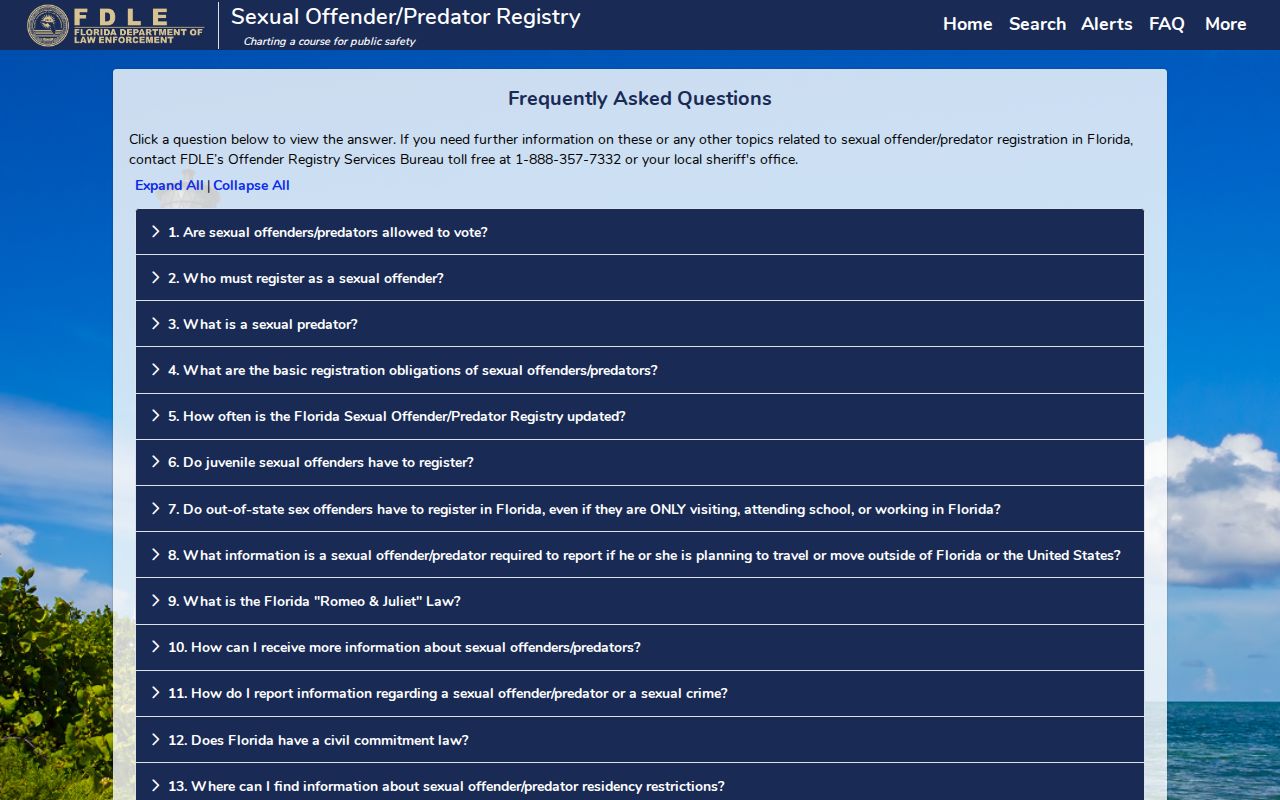
These tools help Brevard County residents keep a dated record of what the official registry reported without republishing private identities.
Alerts are most useful when configured narrowly. A place-based alert can follow the area around a Brevard County address, while a person-based alert follows a selected registry subject. Save notices for personal reference and reopen the official profile to confirm the change. An email subject line alone may omit the date, address type, or custody context needed to understand what happened.
Correcting Brevard Registry Information
When a profile appears wrong, first note the exact field, the profile date, and the source of contrary information. FDLE directs registry questions and corrections to 1-888-357-7332 or sexpred@fdle.state.fl.us, Monday through Friday from 9 a.m. to 5 p.m. Eastern. The agency that supplied the record may need to correct it. A mismatch in an address date should be described differently from a mistaken name, conviction detail, or designation.
Do not confront the listed person. Send the discrepancy through the official channel and keep any case number or response. FDLE's warning that it does not independently verify every submission explains why source-agency follow-up can be necessary.
If the issue concerns a qualifying conviction rather than a current registration field, identify the court and case information shown on the profile. FDLE may need documentation from that jurisdiction. If the issue concerns a reported Brevard address, explain which address type and date appear wrong. Specific facts make it easier for the receiving office to route the inquiry to the agency that supplied the entry.
Brevard Registry Record Boundaries
Florida's registry notice is distinct from a court disposition. The registry shows a current legal registration duty. The court record shows the filed charges and how the prosecution ended. An FDLE criminal-history record serves another purpose. Keeping those sources separate prevents a registry profile from being described as a complete Brevard County criminal record.
The same boundary applies to custody and supervision. A confined or supervised status adds context, but the registry is not the full FDC or county jail record. Use the agency named in the profile when that separate record is needed.
For a Brevard County case, BECA may show the public docket and disposition. For a current jail question, the Sheriff's inmate channel is the proper source. Those records may explain dates seen on a registry profile, yet none should be merged into a claim that the registry itself does not make. Record the source, access date, and exact status for each official system consulted.
Lawful Brevard Registry Use
The registry supports personal safety planning and community awareness. It can help a family understand a nearby listing, follow a reported address change, or check Florida registration information against a national search. It does not authorize threats, surveillance, exclusion, or public punishment. Never approach a person marked absconded. Give location or compliance information to law enforcement or FDLE.
Use registry data lawfully: Florida law prohibits using registry information to harass, threaten, or intimidate a registrant or household. Misuse can be prosecuted under section 775.21.
Confirm time-sensitive facts on the current profile. A saved flyer can age quickly after an address, custody status, vehicle, or photograph changes. The official registry remains the source to revisit.
Community awareness works best when it stays factual. Discuss the public safety plan, not rumors about a listed person. Parents and caregivers can use a radius search to review routes and places, then set clear family rules that apply to all unfamiliar adults. A registry search is one part of safety planning. It does not identify every person who may pose a risk, and absence from results is not a promise of safety.