
Checking Criminal History in Melbourne
Start with the source closest to the Melbourne event. City Police holds its reports, BCSO holds county booking data, BECA holds filed cases, and FDLE maintains the statewide layer. Citizen Connect is a map, not a report-copy system.
- Use Citizen Connect to narrow the date, neighborhood, and incident type.
- Request the report by email, fax, phone, or at the Records window.
- Check BCSO when a Melbourne arrest led to county custody.
- Use BECA for County Court or Circuit Court filings.
- Use FDLE for an official statewide criminal-history search.
Melbourne Police Department Records
The Melbourne Records Division handles city police reports. Email Pd.records.org, call 321-608-6590, or fax 321-608-6599. Operations run Monday through Friday, 8:30 a.m. to 5 p.m.
The lobby opens Tuesday through Friday. Crime reports cover the current plus eight prior years and may be ready next day. Crash reports cover the current plus three prior years. Exempt facts may be redacted.
Melbourne Citizen Connect Records
Melbourne Citizen Connect updates daily and lets a reader filter police activity by neighborhood or incident type. Its locations are generalized. A map point is not an exact address, a police report, or proof that a named person took part in an event.
The official Citizen Connect capture below shows the public awareness interface assigned to Melbourne criminal records research.
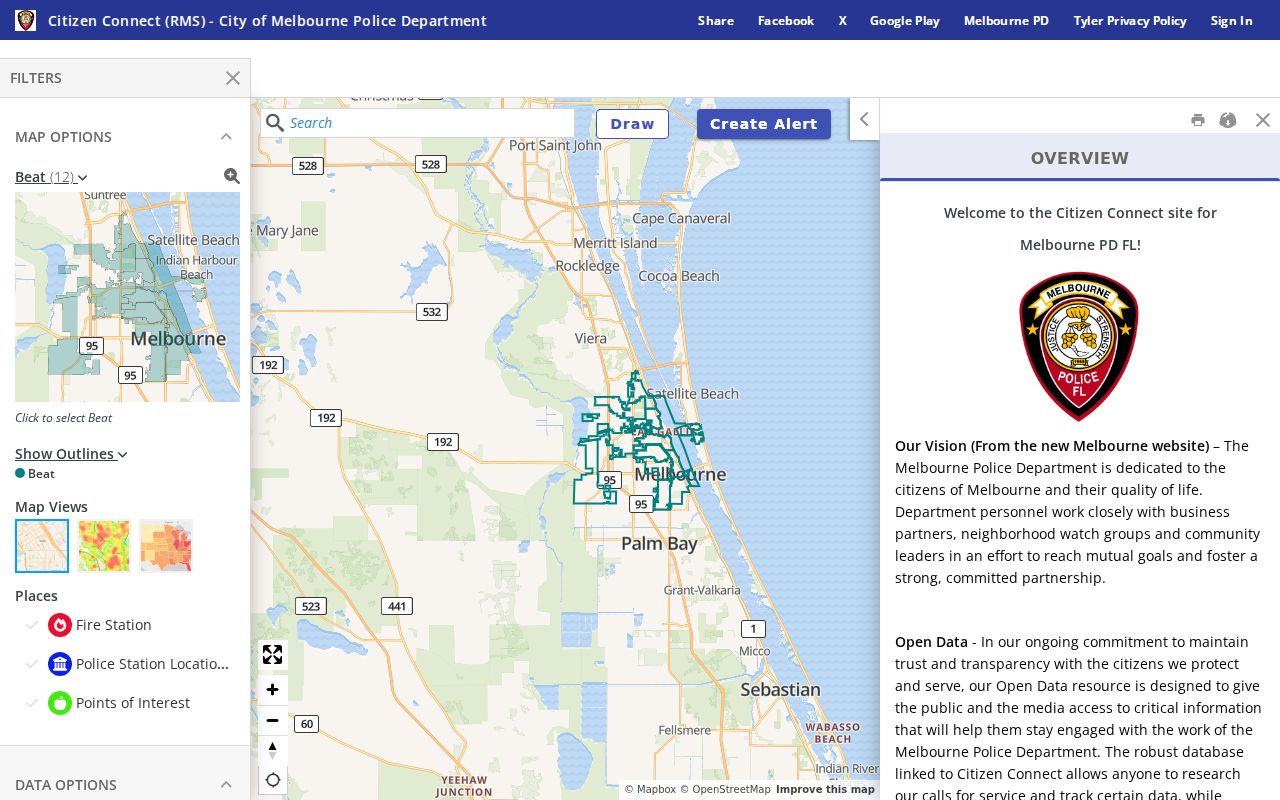
Use the Records Division email, fax, or phone route when the map points to an event whose public report is needed.
Melbourne Arrests and Bookings
No official Melbourne arrest blotter was located. A Melbourne arrestee who enters county custody appears through BCSO, while Melbourne Police keeps the city narrative.
Filed charges appear through BECA. An arrest is not proof of guilt, and booking charges can differ from what prosecutors file.
Melbourne Records Work on Mondays
The lobby window is open Tuesday through Friday from 8:30 a.m. to 5 p.m., yet the Records Division operates Monday through Friday. Monday closes the public window, not the whole office. Staff still process email and fax requests at Pd.records@mlbfl.org and 321-608-6599. Phone help is available at 321-608-6590.
The official Melbourne Records Division page documents those channels. Its successful source capture appears below.
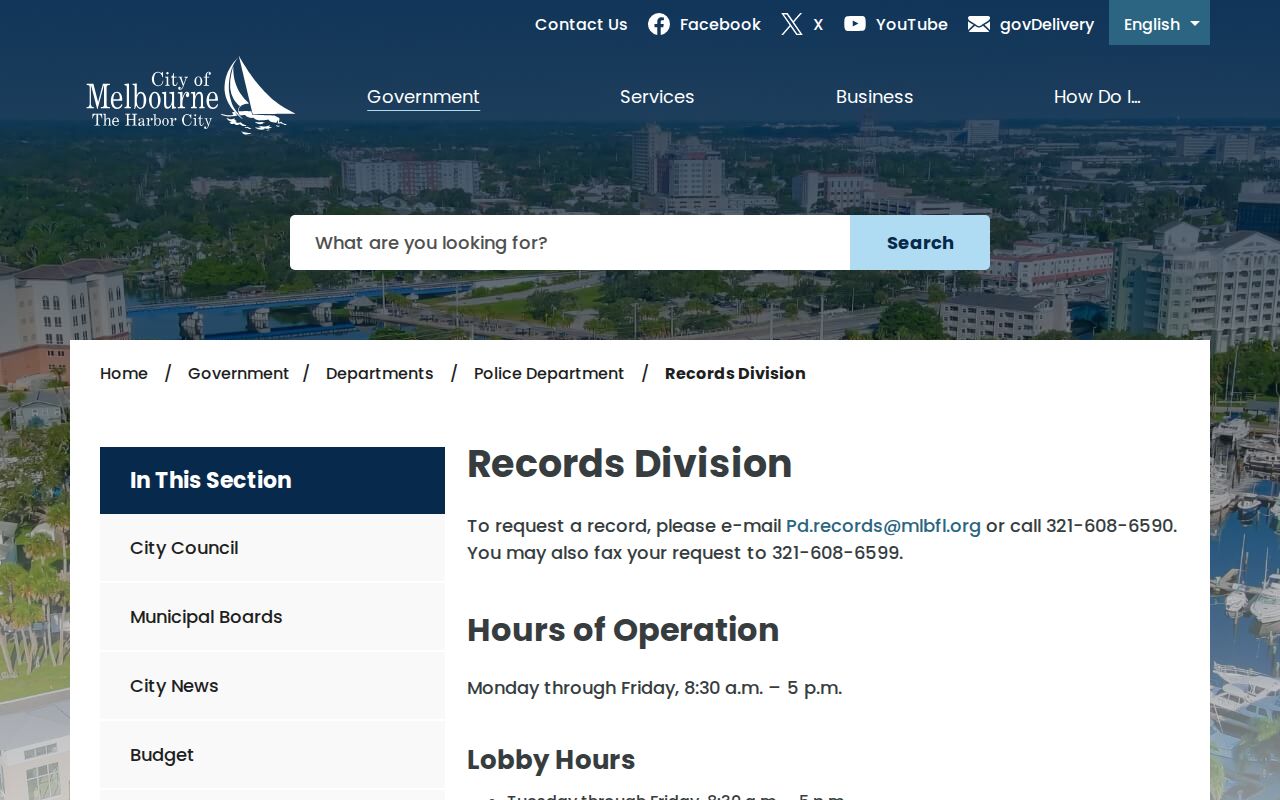
A Monday email can move through back-office review even though a walk-in visitor must wait for Tuesday.
Municipal Court Records in Melbourne
Melbourne has no municipal criminal court. Ordinance, misdemeanor, and criminal-traffic cases go to County Court; felonies go to Circuit Court. Both use the Brevard Clerk and BECA.
| Court Name | Brevard County Court or Circuit Court |
|---|---|
| Case Types Heard | Ordinance, misdemeanor, criminal traffic, and felony cases |
| Case Lookup Channel | BECA, Clerk counter, email, or mail request |
| What the Docket Shows | Charges, actions, disposition, and available images |
| Copies & Fees | $1 per page; $2 certification per document |
Melbourne Crime Report Time Range
Melbourne keeps crime reports available through its Records Division for the current year plus eight prior years. Reports are often ready the next day, subject to investigative review and public-record exemptions. Crash reports use a shorter current-plus-three-year range.
During the first 60 days after a crash, Florida limits access to authorized parties and requires the proper sworn statement. Juvenile data and active investigative material may also be withheld or redacted. The first ten copy pages are free; later pages cost $0.15 one-sided or $0.20 double-sided.
Where Melbourne Records Go
Melbourne Police creates the local report. BCSO adds a booking record, the Clerk adds a case after filing, and qualifying data can reach FDLE.
Record flow: Melbourne PD › Brevard County Courts › Florida Department of Law Enforcement
Recent activity may appear at police or booking level before court filing. For older records, compare BECA and FDLE and obtain a certified Clerk copy when needed.
Melbourne Police Record Custody
The Melbourne Police Department owns reports made by its officers. A county booking entry does not transfer that report to the sheriff. The successful department source image below identifies the city agency behind Melbourne incident and arrest narratives.
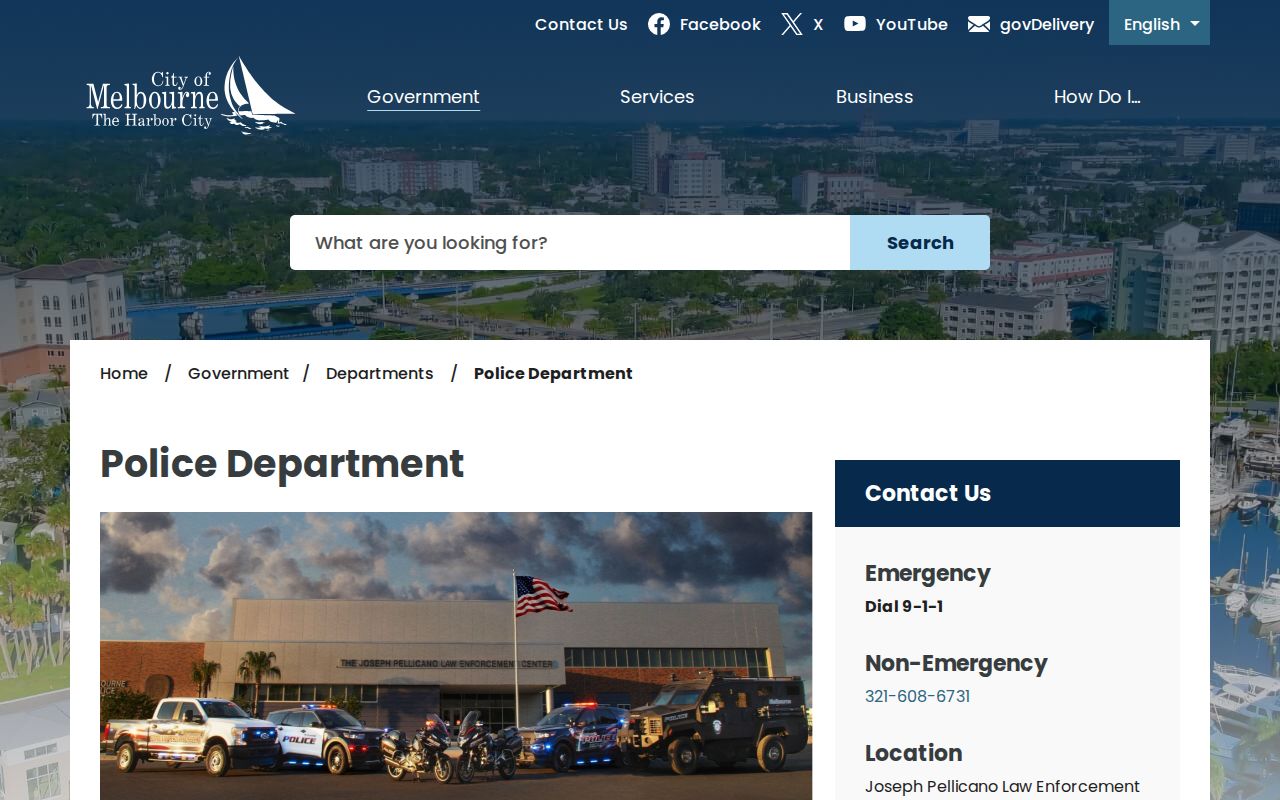
Request the city narrative from Melbourne, the custody profile from BCSO, and the filed case from the Brevard Clerk. The three records can carry different numbers.
Melbourne Crash Record Access
A Melbourne crash report follows a different access clock from a routine crime report. The Records Division covers the current year plus three prior years for crash files. During the first 60 days after a crash, Florida law limits access to authorized people. The requester may need a sworn statement showing the basis for access. Involved drivers, legal representatives, and other groups named in the statute use that restricted route. After the protected period, the public route changes.
This distinction matters because Citizen Connect cannot supply the crash report and a generalized map point does not satisfy the statutory access test. Ask Melbourne Records for the city-held report when Melbourne Police investigated it. The Florida Crash Portal is another official route for qualifying statewide crash requests. Research states that portal reports cost $10 plus a $2 transaction convenience fee, with up to ten reports per transaction and a 48-hour download window. A report can take ten days to appear.
Ongoing investigative facts may still be withheld even when the requester is authorized to obtain the basic crash record. Juvenile facts and protected personal details can also be redacted. If Melbourne does not hold the report, confirm which law-enforcement agency investigated the crash before sending a second request. FHP, another city police department, or a county agency may be the actual custodian.
Melbourne Incident to Court Case
A Melbourne incident number begins in the police system. If officers make an arrest and county custody follows, BCSO creates a booking number. When prosecutors file charges, the Brevard Clerk creates a court case number. Those three identifiers can all concern one event. Citizen Connect may help locate the date and broad area, but its generalized point does not provide the exact location or identify a person.
The practical search sequence depends on timing. For very recent activity, check Citizen Connect and contact Melbourne Records. For custody, use the sheriff's inmate profile fields, which can include booking date, agency, charge, bond, and release status. For charges and outcome, search BECA by case number or permitted name fields. BECA's register of actions shows court events, and an authorized document icon may provide an image. The online record is informational, not the certified court file.
| Melbourne source | What it answers | What it cannot prove |
|---|---|---|
| Citizen Connect | Generalized activity by area and type | Exact address or a person's involvement |
| Police report | City incident and officer narrative | Final court outcome |
| BECA | Filed charges and disposition | Certified status without a Clerk copy |
If the records conflict, compare names, dates of birth, event dates, and identifiers before assuming an error. Melbourne Police can address its report. The Clerk controls the docket and certified disposition. FDLE provides a correction workflow for the statewide history it disseminates. Sending the correction to the office that owns the disputed field avoids delay.
Melbourne's first ten report pages are free. Later pages cost $0.15 for a one-sided page and $0.20 for a double-sided page. Ask for an estimate when a report includes long supplements, photographs, or other media. A request that identifies the exact incident and needed part can reduce search and review time. It can also prevent receipt of pages that do not answer the question.
City context should be used with care. The 2025 Census estimate is 87,097. It also reports that 22.5 percent of residents are age 65 or older and that Melbourne has 8,139 veterans. Those facts can help an office plan accessible records service, but they say nothing about whether a person has a criminal record or whether a neighborhood has more crime. Use the demographics only as civic context.
For a self-review, save the original Melbourne request, the report received, the BCSO booking result if one exists, and the certified court disposition. That set makes it easier to identify which source contains a disputed field. A generalized Citizen Connect point cannot correct a report, and a city records clerk cannot change a Clerk docket. Clear source boundaries make the correction request both faster and more precise.
When no court case appears, verify the spelling, date range, and filing status before drawing a conclusion. Prosecutors may not yet have filed, may have used a different charge, or may have declined the case. Melbourne Records can confirm its report number, but the State Attorney and Clerk channels show whether a prosecution became a docketed Brevard case.
Citizen Connect is most useful as a lead generator. Choose a neighborhood and incident type, note the date, and then contact Records with that narrow description. Because Melbourne generalizes locations, do not turn the plotted point into an assumed street address. Records staff may need an incident number or a tighter time range to identify the public report. If the point reflects a call that did not create the kind of report requested, the Records Division can clarify what responsive material exists.
Monday processing offers a second practical lesson. An office can work on a request while its walk-in window is closed. Email and fax let Melbourne begin review without a trip, while phone contact helps with routing. A person who needs to inspect or collect material in person should use Tuesday through Friday lobby hours. Keep the sent email or fax confirmation, the incident identifiers, and any cost estimate. Those records help distinguish a request that is pending from one sent to the wrong agency or address.
Melbourne's record chain can stop at any stage. Some calls do not lead to an arrest. Some arrests do not lead to filed charges. Some filed charges end without a conviction. That is why a Citizen Connect point, police narrative, booking charge, and court disposition must not be merged into one claim. For personal record review, use the latest official source for each stage and preserve the court's certified outcome. If FDLE does not show that outcome correctly, the certified Clerk record supplies the strongest starting proof for the state correction process.
Citizen Connect updates daily, so it is better suited to broad community awareness than to an urgent custody question. For custody, use BCSO. For an officer narrative, contact Melbourne Records. For a final case result, use the Clerk. A daily map refresh can also occur on a different schedule from report review or court filing. Record the date on which each source was checked. That simple habit helps explain why one Melbourne channel showed an event while another had not yet received the next stage of data.
Public Access Rules in Melbourne
Chapter 119 supports access while protecting active investigations, juvenile facts, victims, and sealed records. Melbourne may redact exempt fields and release the rest.
Key Statutes:
Florida Public Records Law, Chapter 119 sets access and exemptions.
Florida Statutes § 316.066 restricts crash reports for 60 days.
Florida Statutes § 943.053 governs FDLE dissemination.